
Free resources
Pedagogy for Parents
Understanding learning. Protecting children. Strengthening schools. These resources give parents the language and frameworks to understand what happens in the classroom, ask better questions and support their school without interfering.
The starting point
Pedagogy is more than curriculum
What a child learns depends first on the climate of the classroom: the teacher's presence and authority, safety, and the quality of relationships. Content comes after that.
When those foundations are strong, pupils engage, teachers last and learning sticks. When they are weak, anxiety and behaviour problems set in, and even a good curriculum fails.
This is not about judging teachers or schools. The responsibility is shared.
Three roles
From observer to contributor
Three ways for parents to get involved in school life.
Parent-Guardian of Learning
A stance, not a title. This parent understands the difference between pedagogy, governance and management, raises concerns constructively, protects the classroom climate for every child and builds bridges between families and teachers.
Parent-Governor
For parents in formal governance roles. Good governance strengthens safeguarding, leadership and school culture. Poor governance creates fear and politicises learning. Three reminders: presence over power, stewardship over control, long-term culture over quick wins.
Parent-Ambassador (optional)
A voluntary, non-commercial, values-based role: sharing resources, encouraging dialogue with schools and making it normal to talk about the learning climate. Ambassadors do not sell programmes.
The free guide
The Partner Parent Guide
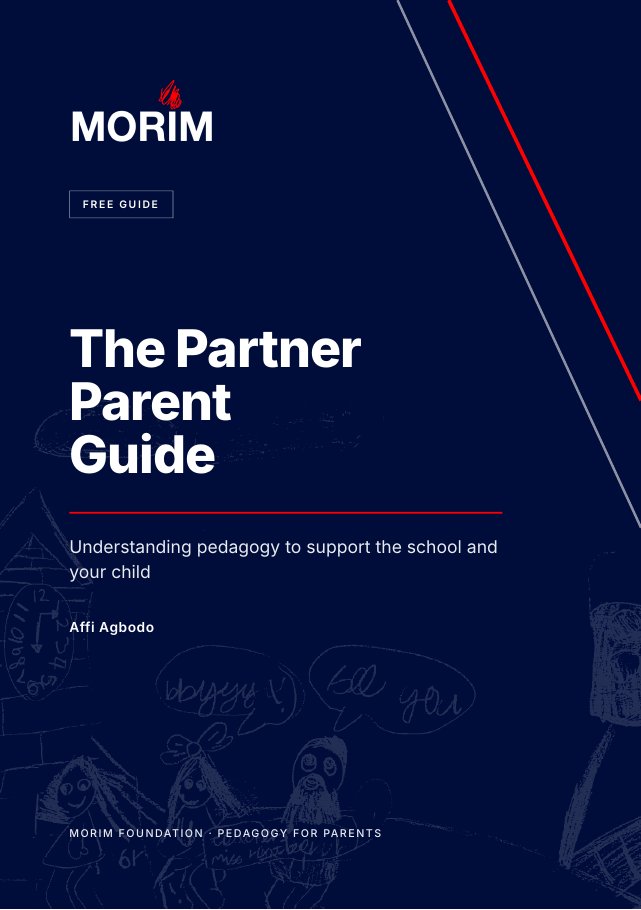
A free 53-page guide by Affi Agbodo, based on the Pedagogy of Heart and Presence™. It shows parents what really matters in a classroom: the Pool of Trust and the Success Project, the teacher's role, the class as a community, and how to work with the school without taking its place.
It also answers the seven fears parents raise most often, with questions to ask the teacher and the head teacher.
Download the guide (PDF) Édition française (PDF)
Questions about the guide? Email us at info@morim.co.uk.
Our commitment. These resources are free. Using them requires no programme registration, implies no endorsement and creates no obligation. Share them, use them with your school and come back to us with questions.